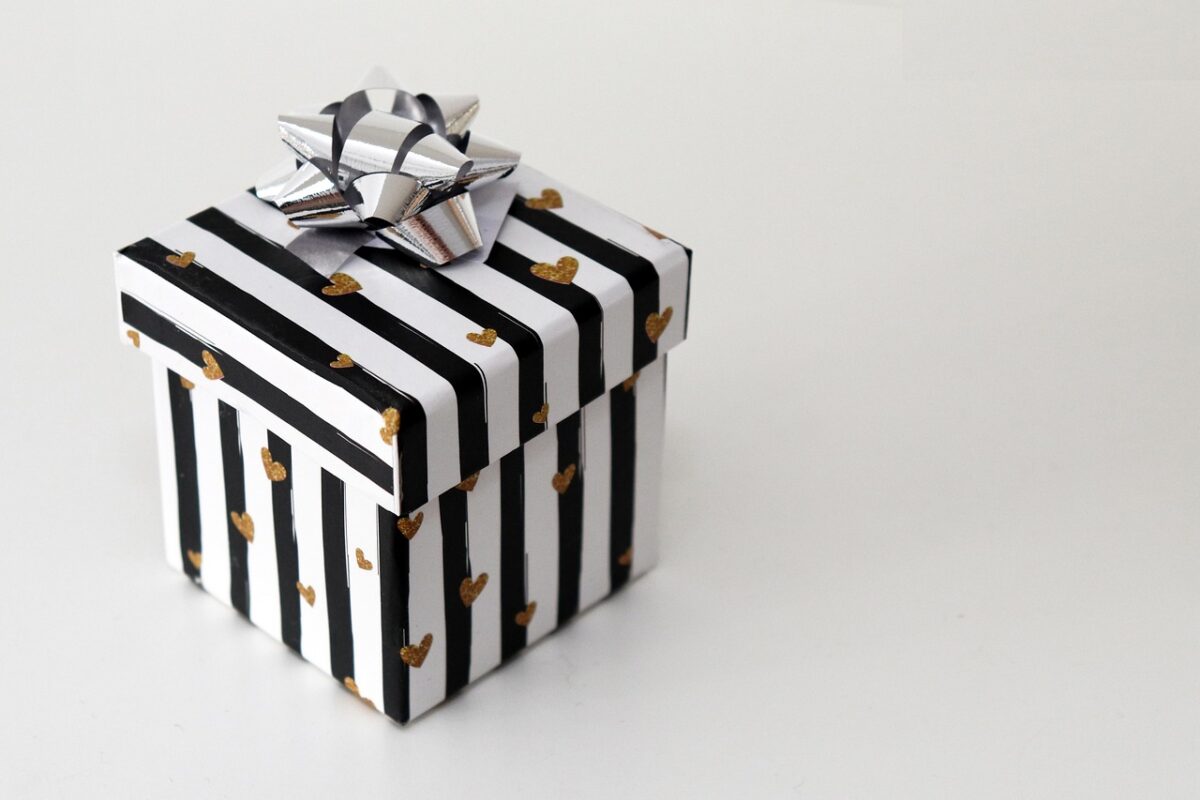
Almost every favour order starts the same way: someone counts the guest list, rounds it up a little, and buys that many. It sounds sensible and it is the single most common reason a couple ends up either twenty short on the morning of the wedding or with four unopened boxes in a cupboard for the next decade. The guest count is a starting point, not an order quantity, and the gap between the two comes down to three things — pack sizes, per-person versus per-place-setting, and the people nobody counts.
Start with places, not people
Decide first whether a favour goes to every person or every place setting. A hand cream and lip balm pair, a bottle opener or a keyring is usually per person. A honey jar, a candle or anything that sits in the middle of a table is often per couple or per table. Those two decisions produce very different numbers from the same guest list: a hundred-guest reception needs a hundred of the first and roughly fifty of the second.
Write the decision down before you look at any products. It is much harder to reason about pack sizes when you have not settled the rule, and it is the point at which most orders quietly drift.
Add the people who are not on the list
There is always a second group: the photographer, the band, the venue coordinator, a late plus-one, the friend who drives someone home. Beyond that there is breakage. Glass jars chip, ribbon frays, one lid arrives cracked and one tag gets water on it during setup.
A practical rule is to add ten per cent to the per-person number and round up to the next whole pack. On a hundred-guest wedding that is a hundred and ten, which — depending on the pack size — usually means buying five packs of twenty-four rather than four.
Let pack size do the rounding
Bulk favours are not sold in ones. They come in twelve, twenty, twenty-four, thirty or fifty, and the pack count is the number that decides your final order. Trying to hit an exact guest count with mixed pack sizes usually costs more than simply buying one pack over.
This is why the pack count sits in the title of every listing on this site rather than three paragraphs into a description. A set of twenty-four hand cream and lip balm pairs is twenty-four pairs — not twenty-four items split into twelve pairs — and that distinction has caught out more than one person ordering at midnight.
A worked example
Ninety guests, favours per person, hand cream and lip balm sets sold in packs of twenty-four. Ninety plus ten per cent is ninety-nine. Ninety-nine divided by twenty-four is 4.1, so five packs, giving a hundred and twenty. That leaves twenty-one spare, which sounds wasteful until you remember the suppliers, the setup crew and the two that will be dropped.
Check what is actually in the box
Favour sets vary enormously in what they include beyond the item itself. Some arrive with organza bags, thank-you cards, ribbon and a pillow box for each unit. Others are the item alone, and the presentation is entirely up to you. That difference can be an hour of your time or a second order for bags at short notice.
Every listing here states what is in the box. If tags and bags are included, the description says so. If they are not, the description says that too, because the alternative is a couple discovering the difference the evening before the wedding.
Order early enough to open a box
Order far enough ahead that you can open one pack, assemble a single favour end to end and see how long it takes. Multiply that by your quantity and you will know whether assembly is a quiet evening or a job for four people. It also gives you time to raise a short or damaged pack under the return policy rather than absorbing it.
The handling and transit windows for standard shipping are set out in full on the shipping policy page, and they are the numbers to plan against — not the day the box happens to arrive.
The short version
- Decide per person or per place setting first.
- Add ten per cent for staff, plus-ones and breakage.
- Round up to whole packs; never mix pack sizes to hit an exact number.
- Read what the pack includes before assuming bags and tags come with it.
- Open one pack as soon as it arrives and assemble a single favour.
Browse the wedding and party favours range, or ask us through the contact page if you would like a second opinion on quantities before you order.
Two situations that change the maths
Children at the reception
Children are usually on the guest list and usually should not get an adult favour — a bottle opener or a hand cream is no use to a seven-year-old, and small parts are a genuine concern with anything under about three. Count them separately, decide whether they get something different or nothing at all, and subtract them from the adult total before you round to packs. A table of eight with three children needs five adult favours, not eight, and multiplied across a room that difference is often a whole pack.
Favours doubling as place cards
If the tag carries a guest’s name and a table number, the favour is doing two jobs and the quantity becomes exact rather than approximate. You need one per named guest, no more and no fewer, and the spares cannot be used because they have the wrong names on them. In that case order the spare pack anyway — blank tags for last-minute additions are worth far more on the day than the money they cost, and a guest arriving without a card is a visible problem in a way that a leftover box in a cupboard is not.
Budget per head, honestly
Work out the real per-head cost by dividing the total order — including the extra pack, the bags and the ribbon — by the guest count rather than by the number of units. That figure is usually a little higher than the shelf price suggests, and it is the number worth comparing between two options.